 EchoLine Pest Control ServiceEchoLine Pest Control Service
Find the entry. Seal it shut.
Pest control in Laurel, MD works best when the inspection comes before the sprayer, because the mouse behind your stove and the roach under your sink got in somewhere specific. Homeowners and landlords searching for pest control near me in South Laurel, West Laurel, Old Town or Russett usually need two things fast: an honest answer about what the pest is, and a firm number before any work starts. Call (240) 917-2799, or text a photo of the bug, the nest, or the droppings and get a straight identification.
Call (240) 917-2799
Text or call about your pest control service job — a quick photo helps us quote fast.
A firm, all-in price confirmed before we start — no surprises.
On time, done to standard, and tidy when we leave.
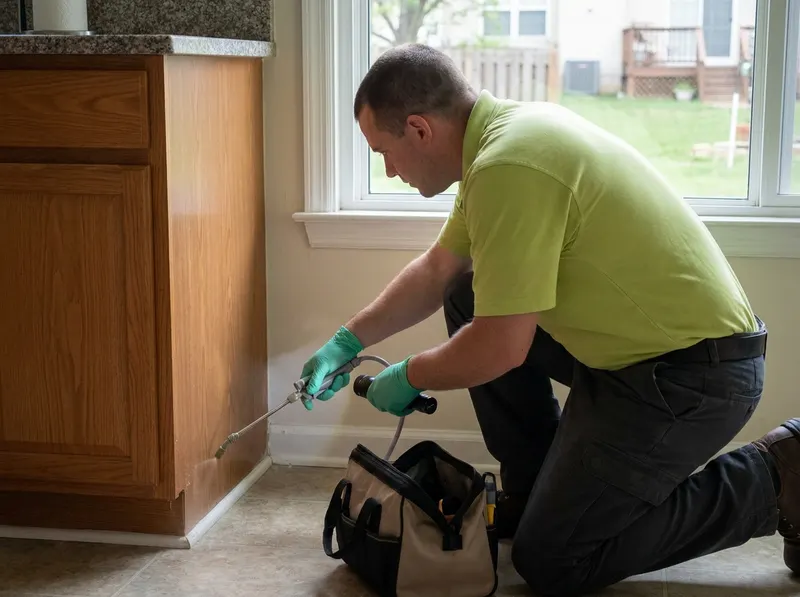
Where you see the roach tells us most of what we need to know. A small tan roach with two dark stripes running across a Laurel kitchen counter at 11 p.m. is a German cockroach, and it is living indoors — behind the dishwasher, in the hinge void of a cabinet, under the fridge motor housing. A large dark reddish-brown roach crossing a basement floor in Old Town Laurel or Bond Mill after a summer downpour is usually an American or Oriental cockroach that came up a floor drain or through a gap around an old cast-iron stack. Same word, two completely different jobs. Treating the second problem with kitchen gel accomplishes nothing, and treating the first with a perimeter spray is why so many homeowners here are on their third company.
The humid corridor along the Patuxent works against you from June through September. Damp crawlspaces and unsealed basements in West Laurel and on the wooded lots toward the Rocky Gorge Reservoir hold enough moisture to support Oriental cockroaches year-round, and storm drains near Granville Gude Park and Laurel Lakes push American roaches toward foundations after heavy rain. Attached housing changes the math again: in South Laurel, Steward Manor and the townhome sections of Russett and Patuxent Greens, German cockroaches travel shared plumbing chases and common walls, so a single unit treated in isolation can be reinfested from next door. For those addresses we treat the unit thoroughly, place monitors, and tell you honestly whether the neighboring unit needs to be included for the result to hold.
<strong>One-time treatment fits Oriental and American cockroach intrusions</strong>, because the fix is physical — seal the plumbing penetration, cap or screen the drain, correct the moisture, treat the void. <strong>German cockroach infestations need at least two visits</strong>, roughly two weeks apart, because egg capsules already laid will hatch after the first treatment and the growth regulator has to catch that second generation. If a company promises a single spray will end a German roach problem, that promise ignores the insect's life cycle. The trade-off is straightforward: baiting takes days to visibly reduce numbers rather than minutes, and it works because the roaches carry it back into voids you cannot reach.
For landlords and property managers working an inspection or turnover deadline in Laurel, tell us the date. Gel and dust placements go into cracks, voids and equipment housings rather than open surfaces, and your technician will give you the label's specific re-entry and ventilation guidance for the products used at your property before leaving — that matters when children, pets or tenants are returning the same day. You get the inspection checklist showing what was found and where, which is also the documentation a Prince George's County or Howard County landlord usually needs on file. Find the entry. Seal it shut.
| Single-unit German roach treatment, kitchen and bath focus | $250 – $375 |
| Two-visit German roach program (initial + follow-up) | $325 – $550 |
| Whole-home roach treatment, larger Laurel single-family home | $450 – $750 |
| Attached townhome or duplex, shared-wall treatment | $350 – $625 |
| Oriental/American roach drain, basement and crawlspace treatment | $275 – $500 |
| Rental unit turnover, per unit (multi-unit scheduled together) | $250 – $400 |
| Heavy infestation cleanout with monitors and follow-ups | $600 – $1,100 |
Most Laurel cockroach treatments fall between $250 and $750, and $250 is the minimum charge for any roach visit. Price depends on species, how many rooms are affected, and whether a follow-up visit is needed for German cockroaches. These are ballparks — the exact figure is confirmed on a free on-site inspection before any treatment begins.
In attached Laurel housing — South Laurel garden apartments, Steward Manor, Russett and Patuxent Greens townhomes — German cockroaches move through shared plumbing chases and wall voids, so a treated unit can be reinfested from an untreated neighbor. Monitors placed after treatment show whether new roaches are arriving from outside the unit, which tells you and your property manager where the source actually is.
Roach work in Laurel homes relies on gel bait, dust and growth regulator placed inside cracks, voids and appliance housings rather than sprayed across floors and countertops where kids and pets spend time. Your technician gives you the specific re-entry and ventilation instructions from the label of every product used at your address before leaving the property.
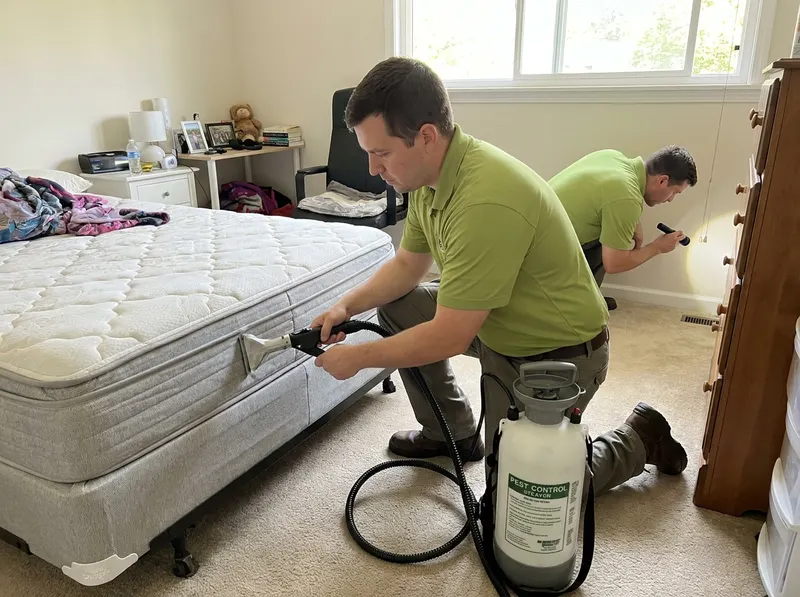
<p>Bed bugs travel on luggage, backpacks, secondhand furniture and moving boxes, which is why the Laurel corridor sees them steadily rather than seasonally. Commuters using the MARC Camden Line and I-95 for hotel stays bring them home in a suitcase. Curb-pickup couches and yard-sale headboards move them between Bond Mill, Steward Manor and Montpelier. In the garden-style buildings around South Laurel and Russett, and in the older walk-ups near the Laurel Main Street Historic District, units share wall voids and baseboard runs — so a bug problem in one apartment is genuinely a building question, and we inspect adjoining rooms and shared walls before we call a job single-unit.</p><p>The decision most Laurel homeowners face is targeted room treatment versus a whole-home program. A targeted single-room treatment fits when activity is confined to one bedroom, bites are recent, and the inspection finds no evidence in the living room furniture or a second bedroom — it is cheaper and faster, and the trade-off is that it depends on the infestation truly being contained. A whole-home program fits when the infestation has been present for weeks, when people have been sleeping on the couch to escape bites (which spreads it), or when a rental unit has turned over with furniture still inside. The trade-off there is cost and prep effort. We tell you which one the evidence supports at the inspection instead of upselling the larger program by default.</p><p>Prep matters more with bed bugs than with any other pest. Strip and bag bedding, run it on the hottest dryer cycle your fabrics allow, and keep the bags sealed until after treatment. Do not move mattresses or furniture into another room, and do not put anything on the curb — both moves relocate the infestation and reset the clock. <strong>Do not throw out the mattress before the inspection</strong>; encasements are usually the cheaper and more effective answer. For landlords and small-property managers, note that sections of Laurel sit in Howard and Anne Arundel County while most of the city is Prince George's County, so tenant-notice expectations can differ by address — we document what was found and what was treated so you have a paper trail for an inspection deadline.</p><p>Re-entry timing is a fair question and the honest answer is a few hours in most cases, after applications have dried and rooms have been ventilated. <strong>Your technician confirms the exact re-entry time on site</strong>, based on the products used and whether there are infants, elderly residents or pets in the home. Follow-up visits are typically spaced two to three weeks apart, and most Laurel bed bug programs resolve across two to three visits over four to six weeks. If we still find live activity at the last visit, we say so plainly rather than declaring the job finished.</p>
| Bed bug inspection with written findings checklist | Free on-site |
| Targeted single-room treatment (one bedroom, confirmed contained) | $250 – $550 |
| One-bedroom apartment or condo, full unit treatment | $500 – $900 |
| Two- to three-bedroom home, multi-room program | $900 – $1,800 |
| Scheduled follow-up visit within the treatment cycle | $250 – $400 |
| Mattress and box spring encasements (market range, per bed) | From $250 |
Bed bug inspections in Laurel are typically scheduled within 24–48 hours, and treatment can often begin at that same visit once live bugs are confirmed and prep is complete. Call (240) 917-2799 and you'll be given an arrival window and the technician's name rather than an all-day guess.
Bed bug treatment in Laurel generally runs $250 to $1,800, with $250 as the minimum charge. A contained single-bedroom treatment sits at the low end; a multi-room program in a larger South Laurel or West Laurel home sits at the high end. Every figure is a ballpark until the free on-site inspection, and the exact price is confirmed in writing before any product is applied.
In most Laurel bed bug jobs, no. Mattresses and box springs are usually treated and then sealed in encasements, which is cheaper than replacement and traps anything left inside. Putting infested furniture on the curb in Old Town Laurel or Patuxent Greens spreads the problem to neighbors and to whoever picks it up, so wait for the inspection before discarding anything.
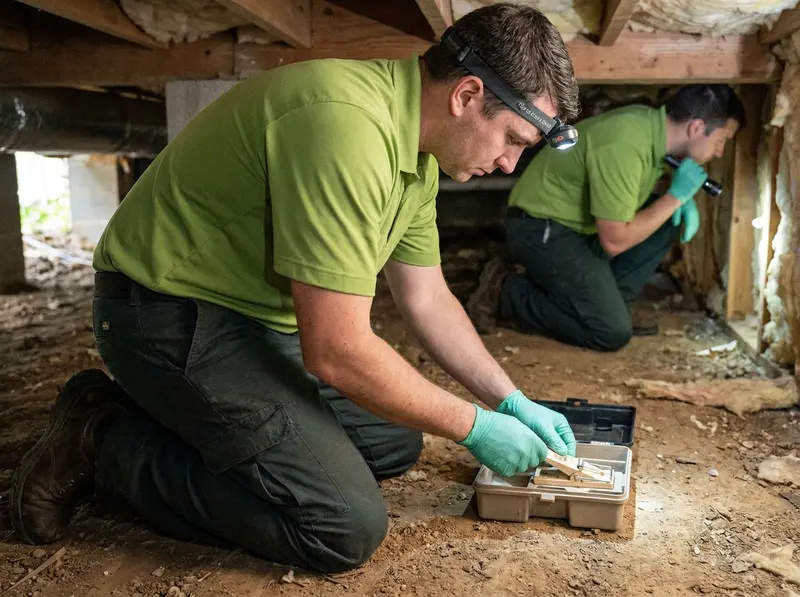
Mice get into Laurel houses through openings most homeowners never look at. In Old Town Laurel and the Main Street Historic District, older masonry foundations, mortar loss and weep holes give a mouse a straight path to the sill plate; a quarter-inch gap is enough. In slab-built townhomes around Russett, Patuxent Greens and parts of South Laurel, the common routes are the plumbing and HVAC penetrations behind the dishwasher and under the sink, plus the corners of the garage door where the rubber sweep has worn away. West Laurel and North Laurel homes on larger wooded lots near the Rocky Gorge Reservoir and the edges of the Patuxent Research Refuge deal with more crawlspace pressure — vents with damaged screen, and mice moving inside as field cover dies back. <strong>Every mouse job we run starts with locating the entry, because sealing is what makes the result permanent.</strong>
The seasonal pattern here is consistent. Calls climb sharply from late September through December as overnight temperatures drop and mice move from field margins, drainage swales and the meadow edges near Granville Gude Park toward heated foundations. Winter calls are usually established populations already nesting in insulation. Spring and summer calls tend to be single mice tracking a specific food source — a bird seed bin in the garage, pet food in a Bond Mill basement, a compost pile against a Steward Manor foundation wall. Knowing which pattern you have changes the plan: one traveling mouse needs targeted trapping and one gap closed, while a nesting group in a Montpelier-area crawlspace needs a full perimeter pass and staged follow-up.
<strong>Mouse control fits when you have droppings, gnaw marks, grease rubs along baseboards, or night scratching in walls.</strong> If you are seeing large droppings, hearing heavier movement in the attic, or finding chewed HVAC ducting and insulation pulled into mounds, that is rat or larger-rodent territory and gets a different inspection and different hardware. The honest trade-off with mouse work is the exclusion side: a trapping-only visit is cheaper up front and will drop the population fast, but in a Laurel home with an open crawlspace or aged brick, the mice return within weeks. Sealing costs more the first time and is the reason you stop calling. <strong>We will always tell you which portions of the sealing we can reach and which need a carpenter or mason instead of a pest technician.</strong>
Safety and placement matter to families and tenants. Interior stations go in enclosed, tamper-resistant placements or inside wall voids and appliance kick spaces where children and pets cannot reach them, and we will show you every location we use before we leave. For landlords and property managers working against a tenant complaint or an inspection deadline in Laurel Lakes or South Laurel, we document the entry points and the work performed in writing so you have something to hand over. Find the entry. Seal it shut. Call <strong>(240) 917-2799</strong> to schedule the on-site inspection.
| Mouse inspection with written entry-point checklist and initial trapping (minimum service) | $250 |
| Standard single-family mouse service: trapping, station placement and follow-up visit | $300 - $475 |
| Mouse service with targeted exclusion sealing (garage sweep corners, utility penetrations, vent screening) | $425 - $700 |
| Larger or multi-level home with crawlspace or attic activity and full perimeter exclusion | $650 - $900 |
| Additional follow-up visit after the included one | From $250 |
Mouse control in Laurel typically runs $250 to $900, with $250 as our minimum charge. The range depends on square footage, foundation type and how much sealing is required — a slab townhome in Russett with two utility penetrations is far less work than a West Laurel home with an open crawlspace. These are ballparks; the exact price is confirmed in writing during the free on-site visit, before any work starts.
Most Laurel mouse calls are scheduled within 24 to 48 hours. You get an arrival window and the technician's name rather than an open-ended day. Trapping typically knocks down the visible activity in the first week, and the follow-up visit confirms whether the entry points we sealed have stopped new mice from coming in.
Yes, when placements are controlled. In Laurel homes we use enclosed, tamper-resistant stations and put interior devices inside wall voids, under appliances and in utility spaces that children and pets cannot access. We walk you through every placement location before leaving, and mouse work does not require you to vacate the house the way some liquid treatments do.
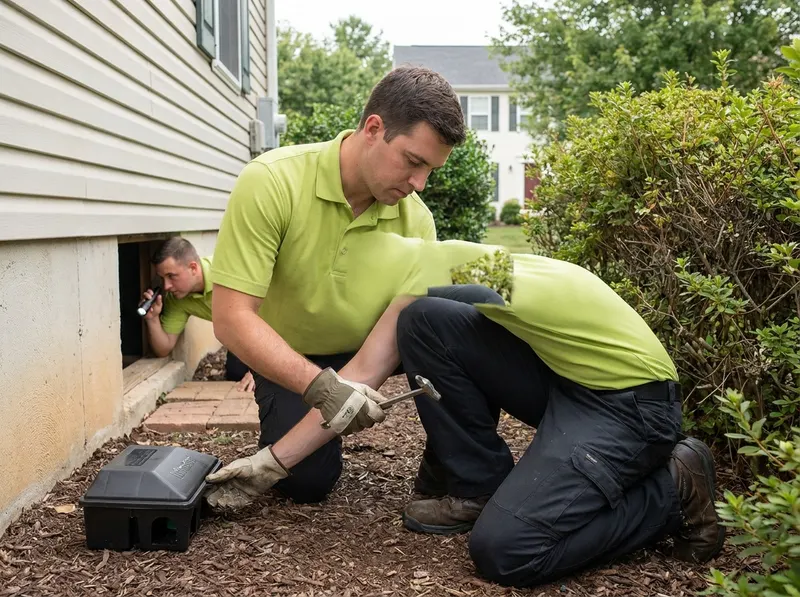
Norway rats dominate rat calls across Laurel, and they behave like a ground-and-water animal: they burrow in soft soil, travel established runways, and stay close to food and cover. That biology explains the local pattern. Properties along the Patuxent River corridor near Riverfront Park, the low ground around Granville Gude Park and Laurel Lakes, and the older alleys behind the Laurel Main Street Historic District give rats exactly what they want — bank soil, dense ivy and English ivy beds, storm drains, and dumpsters. From there they push into buildings at ground level, not at the roof. <strong>The first thing we look for on a Laurel rat job is exterior burrows and a rub-marked runway, because those tell us where the population lives before we ever open a bait station.</strong>
Housing stock changes the fix street by street. In Old Town Laurel, brick and wood-frame homes with unsealed crawlspace vents, deteriorated mortar and open utility chases are the common route in. In South Laurel and Steward Manor, garden-apartment and townhouse blocks share walls, so a single unsealed water-line penetration can feed several units and one-unit-only treatment fails. Newer slab-built homes in Russett and Patuxent Greens rarely have crawlspace issues but frequently have a worn garage door bottom seal or a gap where the sill plate meets the block. Larger West Laurel and North Laurel lots near the Patuxent Research Refuge and the Rocky Gorge Reservoir edge bring wood piles, sheds, backyard chickens and compost into the picture, and rats will nest under a shed floor for years without entering the house. Montpelier and Bond Mill properties with mature landscaping and long fence lines often show burrow entrances tucked behind shrubs against the foundation. <strong>A rat cannot be excluded with foam or steel wool alone — openings larger than a half inch need hardware cloth, sheet metal or mortar to hold.</strong>
When does rat work fit versus a general rodent visit? If you are seeing droppings the size of a rice grain and hearing light scratching in a wall, that is usually mice, and mouse work is faster and cheaper. Rats mean larger capsule-shaped droppings, greasy rub marks along baseboards or joists, deep gnaw damage on wood or plastic, two-to-three-inch burrow holes in the yard, and heavy nighttime movement. <strong>Rat jobs cost more than mouse jobs because rats require exclusion carpentry, more visits, and outdoor burrow work — not more chemical.</strong> The trade-off is real and worth naming: baiting alone is cheaper up front but can leave a rodent dying inside a wall cavity, which creates an odor problem and a fly problem. For that reason we lean on interior snap trapping and monitored exterior stations, and we tell you plainly which approach we're using in your home and why.
Safety questions get answered before anything is placed. Any exterior rodenticide is used in <strong>locked, tamper-resistant stations secured to the ground or wall</strong>, kept out of play areas, and interior devices are set in concealed voids, behind appliances, or in the crawlspace rather than in open living space. Homes with toddlers, dogs or cats can be run trap-only on request. There is no chemical fog and no re-entry wait for standard rat trapping. What you get at the end of the inspection is the same thing a Prince George's County landlord or a buyer facing a settlement deadline needs: a documented list of entry points, what was sealed, and what's still open. Sections of Laurel fall into Howard and Anne Arundel County as well, and we service all three sides of the line. Find the entry. Seal it shut.
| Rat inspection with same-visit trapping and station setup (minimum charge) | $250 |
| Single-family rat program — initial visit plus 2–3 follow-ups | $375 – $700 |
| Larger or heavily infested property, multiple burrows or crawlspace involvement | $600 – $900 |
| Rodent exclusion / entry-point sealing (hardware cloth, sheet metal, mortar patch) | $250 – $1,200 depending on scope |
| Exterior burrow and station maintenance visit (ongoing, after initial program) | $250 minimum per visit |
| Townhouse or multi-unit rat service, per building assessment | quoted on-site after inspection |
Rat control in Laurel typically ranges from $250 to $900, with $250 as the minimum charge for any rat service. The figure depends on how many burrows are active, whether the crawlspace is involved, and how much sealing the structure needs. These are ballparks — the exact price is confirmed in writing during a free on-site inspection before any work begins.
Rats leave capsule-shaped droppings roughly three quarters of an inch long, greasy rub marks along baseboards and joists, deep gnaw damage, and two-to-three-inch burrow holes in the yard; mice leave rice-grain droppings and lighter damage. In Laurel, yard burrows near foundations, ivy beds and shed slabs are the clearest rat sign. The inspection confirms which species you have before pricing the job.
Norway rats are burrowing animals that favor soft soil, water and continuous cover, which the Patuxent River corridor, the low ground near Granville Gude Park and Laurel Lakes, and the alley and dumpster lines behind Laurel's Main Street Historic District all provide. Rats then enter nearby buildings at ground level through foundation gaps, utility penetrations and crawlspace vents rather than from the roof.
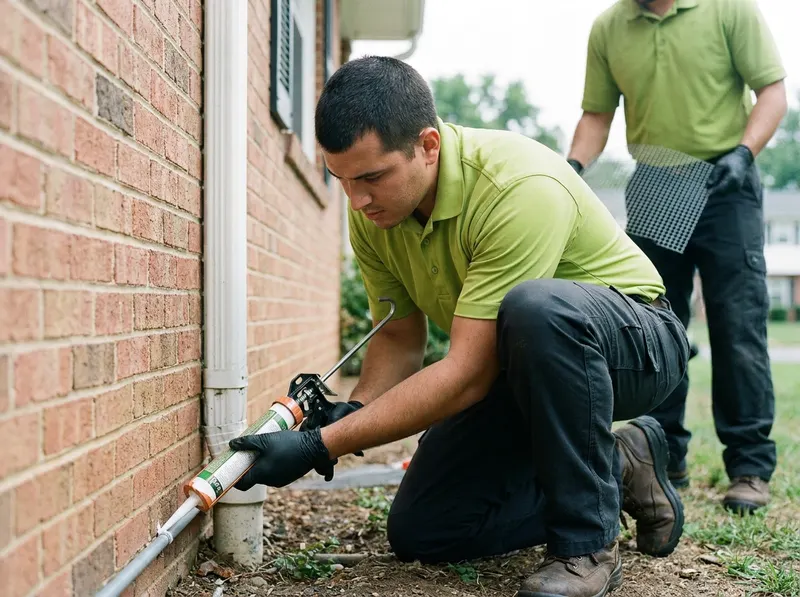
Exclusion is the step most rodent problems in Laurel are missing. Bait and snap traps reduce the population that is already inside; they do nothing about the quarter-inch gap under the garage door corner or the chewed dryer vent flap that lets the next group in three weeks later. <strong>Sealing entry points is the only part of rodent work that permanently changes the house.</strong> If a previous company treated twice and the scratching came back both times, the gaps were never closed.
Housing stock across Laurel dictates where we look. In Old Town Laurel and the Laurel Main Street Historic District, older brick and wood-frame homes have settled stone or block foundations with open mortar joints and generous sill-plate seams behind the shrub line — slow, quiet entry that shows up as droppings in a basement corner long before anything is seen upstairs. Townhomes and slab-built homes in Russett, South Laurel, and Patuxent Greens tend to fail at manufactured openings instead: garage door bottom seals, corner gaps where the door meets the jamb, kitchen plumbing penetrations, and shared utility chases. Crawlspace homes around Bond Mill and Steward Manor need vent screening and rim-joist work more than anything else. On the wooded, deeper lots of West Laurel and North Laurel — close to the Patuxent Research Refuge and the T. Howard Duckett (Rocky Gorge) Reservoir — white-footed and deer mice press inward every October as fields cool, and mature tree limbs over Montpelier rooflines hand rodents direct access to soffit returns and gable vents.
Choose exclusion when the pattern repeats: droppings that return after cleanup, gnawing along baseboards, grease marks on a foundation, or a rental unit where the same complaint keeps landing on you. Choose trapping alone when a single mouse walked in through a propped door and there is no evidence of a runway. The honest trade-off is that <strong>exclusion costs more up front and takes longer than a spray-and-go visit</strong> — carpentry-grade work on 20 or more openings is not a fifteen-minute stop. What you buy is the end of the cycle, and far less chemical in a house with kids, cats, or dogs, since sealed steel does not need a re-application date.
How the visit runs, so nothing is a surprise: we walk the full perimeter and the interior — basement, crawlspace hatch, under-sink cabinets, behind the stove and refrigerator, laundry penetrations, attic access where safe — and <strong>you receive the entry-point checklist in writing</strong>, gap by gap, with a price attached before work starts. Active infestations get trapping placed alongside sealing so nothing is closed inside the walls. We give an arrival window rather than "sometime Tuesday," tell you the technician's name, and note in advance what to clear from under sinks or off the garage wall. Laurel sections falling into Howard County and Anne Arundel County are served on the same schedule as Prince George's County addresses.
Call (240) 917-2799 to book the assessment. <strong>Find the entry. Seal it shut.</strong>
| Rodent entry-point inspection with written checklist (credited toward sealing work) | $250 |
| Targeted exclusion, single area — 3–6 entry points (garage, kitchen, or laundry wall) | $350–$650 |
| Garage door seal, sweep, and corner-gap sealing | $250–$450 |
| Crawlspace vent screening and rim-joist sealing | $300–$800 |
| Full-perimeter exclusion, typical Laurel single-family home | $700–$1,600 |
| Roofline, soffit, and gable vent sealing (ladder access) | $450–$1,200 |
| Combined trapping program plus exclusion for an active infestation | $500–$1,200 |
Rodent exclusion in Laurel starts at $250 and most jobs land between $350 and $1,600, driven by the number of entry points and whether ladder or crawlspace access is needed. Those figures are ballparks in line with the local market; the exact price is confirmed in writing during the free on-site inspection, before any sealing begins.
If rodents are currently active inside a Laurel home, sealing alone is not enough — trapping runs alongside the exclusion so nothing gets closed in behind a wall. Once the interior population is cleared and the gaps are shut, most homes need no ongoing bait at all, which is the practical difference between exclusion and a recurring chemical plan.
In Old Town Laurel and the surrounding historic district, the common entries are open mortar joints in stone or block foundations, sill-plate seams behind the foundation shrubs, utility and gas line penetrations, and basement window frames that have shifted. These homes rarely have one hole — they have a series of small ones along the same elevation, which is why the written checklist matters.
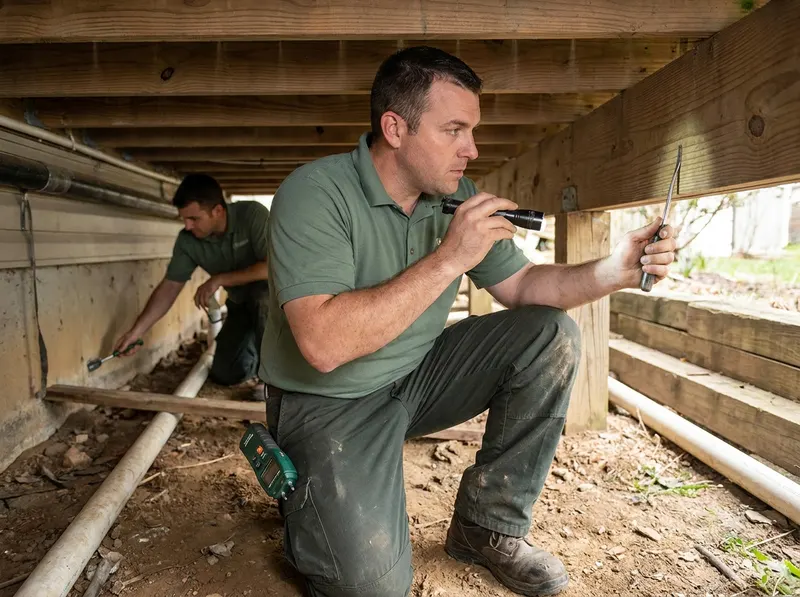
<p>Termites in Laurel are driven by soil moisture, and Laurel has plenty of it. Properties near the Patuxent River corridor, Riverfront Park, and the low ground around Granville Gude Park and Laurel Lakes hold water in the mulch beds and grade against the foundation, which is exactly the wet-soil-to-dry-wood bridge subterranean termites need. Older wood-frame and brick homes in the Laurel Main Street Historic District and Old Town Laurel often have shallow crawlspaces, original sill plates, and porch posts set close to grade — the first places we probe. In West Laurel and North Laurel, wooded lots near the T. Howard Duckett (Rocky Gorge) Reservoir mean buried stumps, landscape timbers, and firewood stacked against siding all become feeding stations within reach of the house. In slab-built neighborhoods like Russett, Patuxent Greens, and parts of South Laurel, there is no crawlspace to read, so the inspection shifts to <strong>expansion joints, plumbing penetrations, bath traps, and the garage-to-slab seam</strong> where mud tubes surface.</p><p>An inspection is the right call in three situations. First, you saw a swarm — dark winged insects at a window in spring, or a pile of equal-length shed wings on a sill. <strong>Swarming in Maryland typically runs from March into May, often on the first warm, humid day after rain</strong>, and swarmers coming from inside the structure mean an active colony, not a fly-by. Second, you found suspect damage: paint that blisters in a line, baseboard that gives under a screwdriver, or a thin mud-colored ridge running up a block wall. Third, a lender, buyer, or tenant turnover is forcing paperwork on a deadline. If your closing requires a written wood-destroying insect report, say so when you book so we confirm the correct documentation and licensing scope before the appointment rather than after.</p><p>Here is the honest trade-off. An inspection tells you whether termites are present, where they are entering, and what conditions are feeding them — it does not kill anything. If evidence is found, treatment is a separate decision and a separate cost, usually a soil-applied liquid barrier around the foundation, targeted foam into voids, or a bait system where drilling and trenching are impractical. If <strong>no evidence is found</strong>, you get the conditions list instead: grade too high against the siding, mulch stacked over the brick line, a downspout dumping at the corner, a crawlspace vapor barrier that stopped short. Fixing those is often cheap and is the difference between a clean inspection now and a colony next spring. That is also the honest answer to "do I need a recurring plan" — for termites specifically, many Laurel homes need a one-time inspection plus an annual re-check, not a monthly visit.</p><p>Prices below are <strong>ballparks for the Laurel market</strong>, and the exact figure is confirmed on site before any work begins, because crawlspace height, finished-basement coverage, and building count change the scope. We do not start and bill later. <strong>Nothing is applied on an inspection visit</strong>, so there is no re-entry wait, no odor, and nothing for children or pets to avoid on inspection day; if treatment is recommended, we walk through the product, placement, and re-entry timing before you approve it. Call (240) 917-2799 for a Laurel termite inspection with an arrival window you can plan around. <strong>Find the entry. Seal it shut.</strong></p>
| Standard termite inspection, single-family home (up to ~2,000 sq ft) | from $250 |
| Larger or multi-level home, or added crawlspace access | $250–$375 |
| Inspection with written findings for a sale, refinance, or tenant turnover | $275–$425 |
| Duplex or small multi-unit building (per building) | $300–$500 |
| Re-inspection after treatment, repairs, or grading corrections | $250–$325 |
| Detached garage, shed, or outbuilding added to the same visit | $250–$300 |
Termite inspections in Laurel start at $250, and most single-family homes land between $250 and $425. Size, crawlspace access, number of buildings, and whether you need written documentation for a closing move the number. The figure is a ballpark until the technician sees the property; the exact price is confirmed on site before any work starts.
Eastern subterranean termites in the Laurel area typically swarm from March into May, often on the first warm, humid afternoon after rain. Swarmers emerging outdoors near a stump or landscape timber may be from a yard colony; swarmers appearing indoors, or shed wings on interior windowsills, point to a colony with access to the structure. An inspection determines which one you have.
Yes. Slab-on-grade homes in Russett, Patuxent Greens, and South Laurel are inspected along the exterior foundation line, at expansion joints and plumbing penetrations, at the garage-to-slab seam, and around bath traps and utility chases where subterranean termites surface. Interior baseboards, door frames, and any wood in contact with concrete are probed as well.
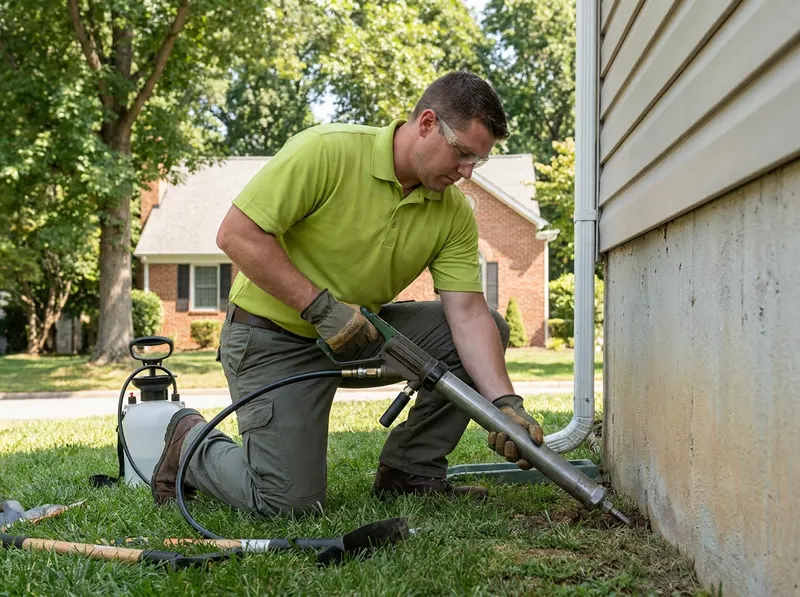
Termites are diagnosed differently than roaches or mice, and the diagnosis drives everything. Spring is when most Laurel homeowners find out: warm rain in late March through May triggers swarms of dark, winged reproductives, and they pile up against storm windows and basement window wells, or leave small piles of discarded wings on a sill. Swarmers indoors mean an active colony is already in contact with the structure. The quieter evidence matters just as much — pencil-thin mud tubes climbing a block foundation, blistered paint on a basement trim board, a hollow tap along a garage door jamb, or soft wood where a deck post meets soil. <strong>Finding the entry point is the treatment plan; the chemical is only the delivery.</strong>
Construction type in Laurel varies enough that a single approach doesn't fit every street. The older brick and wood-frame houses in Old Town Laurel and near the Laurel Main Street Historic District often sit on block foundations with partial crawlspaces, where piers, sill plates and floor joists get inspected from below. Slab-on-grade homes are common through South Laurel, Russett and the newer sections of Patuxent Greens, and a liquid barrier there usually requires drilling and treating through the concrete at expansion joints and along the interior perimeter of the garage. West Laurel and Bond Mill properties on wooded lots carry a different pressure — heavy leaf litter, landscape timbers, and mulch pushed above the brick line create soil-to-wood contact right where termites forage. Homes near standing water and dense tree cover, from the edges of the Patuxent Research Refuge to the low ground along the Patuxent River near Riverfront Park and the Rocky Gorge Reservoir corridor, tend to hold moisture longer after storms, and consistent soil moisture keeps colonies active close to foundations.
The main decision is <strong>liquid barrier versus bait system</strong>. A liquid soil treatment applied in a trench around the foundation (and injected through slabs where needed) works fast and creates a treated zone termites cannot cross without picking up the active ingredient — the better fit when there is active damage, a closing deadline, or a structure you want protected immediately. In-ground bait stations installed around the perimeter work more slowly but eliminate the foraging colony over weeks to months and are easier to maintain on properties where trenching is obstructed by patios, dense plantings, or hardscape — common in townhome rows through Steward Manor and Laurel Lakes. Baits require scheduled monitoring; barriers require re-treatment years later. A localized spot treatment can be appropriate for a single isolated area, like one damaged deck post or a garage door frame, but it protects that area only and is not a substitute for whole-structure protection when mud tubing appears in more than one location.
On safety and access: termite work is applied to soil, foundation walls and drilled slab points rather than sprayed across living areas, so occupied rooms are generally undisturbed. Ask for the product label and re-entry guidance for your specific application, and expect a straight answer. Termite applications in Maryland are regulated pesticide work — confirm the applicator's credentials and get the scope in writing before anyone breaks ground. <strong>Landlords and sellers</strong> in Montpelier, North Laurel and the Howard County sections of Laurel often need documentation for a settlement date; say so when you call so the inspection and any required report are scheduled against your deadline instead of behind it.
| Termite inspection with written findings and entry-point diagram (quoting visit) | Free on-site |
| Localized spot treatment, single area (deck post, door jamb, isolated tubing) | $250 – $600 |
| Crawlspace-focused treatment, piers and sill plate perimeter | $700 – $1,600 |
| Full-perimeter liquid barrier, typical Laurel single-family home | $1,200 – $2,800 |
| Slab-on-grade home requiring concrete drilling and injection | $1,400 – $3,200 |
| In-ground bait station system, perimeter installation | $900 – $1,900 |
| Annual monitoring / bait station service visit | $250–$350 |
| Wood-destroying insect report for a sale or refinance | From $250 |
Full-perimeter termite treatment on a typical Laurel home generally runs $1,200–$2,800, and localized spot treatments start at our $250 minimum. Price is driven by linear foundation footage, whether the home is slab or crawlspace, and how much concrete needs drilling — all measured during the free on-site inspection, with the exact figure confirmed in writing before work starts.
Eastern subterranean termites in Laurel typically swarm from late March through May, usually on warm afternoons a day or two after rain. Swarmers found inside the house — on basement window wells, sills, or near a slab crack — indicate an active colony in contact with the structure and warrant an inspection. Winged termites outside in the yard or mulch are common in the area and do not by themselves confirm the home is infested.
Liquid barriers are the faster option and the better fit for Laurel homes with active tubing, visible damage, or a settlement deadline, because the treated soil zone protects the structure right away. Bait stations suit properties where trenching is blocked by patios, walkways or dense plantings — frequent in townhome sections of Laurel Lakes and Steward Manor — and eliminate the foraging colony over weeks to months with scheduled monitoring visits.
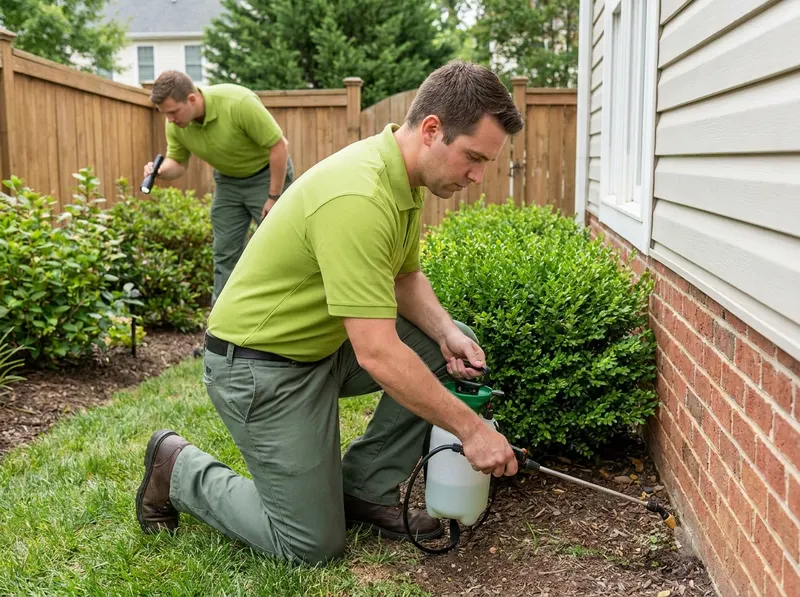
Ant species decides the treatment, so identification comes first. Pavement ants push soil out of expansion joints along driveways and sidewalks and are common in Laurel Lakes and Steward Manor, where they nest under slab edges and travel indoors through the sill plate. Odorous house ants — the ones that smell faintly of coconut when crushed — build satellite nests inside wall voids and under insulation, which is why they reappear a week after a store-bought spray. Carpenter ants are the ones worth taking seriously on wooded lots in <strong>West Laurel and North Laurel</strong>, near the treelines around the Patuxent Research Refuge and the Rocky Gorge Reservoir buffer, because they excavate damp structural wood rather than eat it and often start in a rain-soaked fascia board, deck ledger or window header.
Housing stock shapes the entry points, too. In the brick and masonry homes around <strong>Old Town Laurel and the Laurel Main Street Historic District</strong>, ants exploit mortar gaps, weep holes and the gap behind old wood trim. Slab-on-grade homes in Russett, Patuxent Greens and parts of South Laurel typically get ants at plumbing and electrical penetrations, where a bath trap or dishwasher line passes through concrete. Crawlspace homes in Bond Mill and Montpelier bring a moisture question with them — damp joists and low ventilation attract the same ants twice. That is the reason the inspection checklist you receive lists mulch depth, downspout discharge, tree limbs touching the roof and grade contact, not just where the spray went.
One-time treatment versus a recurring plan is a real decision, not an upsell. A <strong>single treatment fits</strong> an isolated indoor trail with one identifiable nest — a spring pavement ant line at a patio door, or a small odorous house ant colony behind a kitchen backsplash. A <strong>quarterly plan fits</strong> properties with repeat pressure: wooded lots, homes backing to Granville Gude Park and Laurel Lakes or the Patuxent River corridor at Riverfront Park, mulch-heavy landscaping, and rental units where tenant reporting is delayed. The trade-off is honest: one-time costs less today and can absolutely solve a contained problem, while a plan holds the exterior barrier through the heavy pressure months and catches carpenter ant swarmers before they establish. Laurel's ant calendar peaks twice — after the first warm rains in April and May when colonies move to forage, and again in the humid late-summer stretch when nests split and go looking for water inside.
Safety and re-entry get answered before we start. Baits are placed in cracks, voids and tamper-resistant stations rather than open surfaces where children and pets reach, and any liquid application gets a specific dry time before normal use of the area. We tell you what to move off counters and out from under sinks in advance, and if the inspection shows the real driver is a leaking supply line or a downspout dumping against the foundation, we say so plainly — because sealing the entry is what keeps the ants out. Find the entry. Seal it shut.
| Standard ant treatment, interior trails + exterior perimeter (single-family or townhome) | $250 - $450 |
| Odorous house ant / multi-nest interior baiting program (kitchen, baths, wall voids) | $300 - $525 |
| Carpenter ant treatment with moisture and wood-contact inspection | $375 - $750 |
| Ant service for rentals or small multi-unit buildings (per building, unit count dependent) | $325 - $700 |
| Quarterly perimeter and ant prevention plan (per visit) | $250 - $350 |
Ant control in Laurel starts at $250, and most single-family and townhome treatments fall between $250 and $450. Carpenter ant work runs higher, generally $375 to $750, because it includes tracing damp structural wood and satellite nests. Every figure here is a ballpark — the exact price is confirmed in writing during the free on-site inspection, before any product is applied.
Ants return in Laurel homes because surface sprays kill foragers while the queen and satellite nests stay intact, and repellent products can even split a colony into more trails. Lasting control uses baits the workers carry back to the nest, plus sealing the specific entry — mortar gaps in Old Town Laurel brick, slab penetrations in Russett and South Laurel, or sill-plate gaps under a patio door.
Odorous house ants and pavement ants are the most common indoor ants in Laurel, with pavement ants pushing soil from driveway and sidewalk joints in neighborhoods like Laurel Lakes and Steward Manor. Carpenter ants show up most on wooded lots in West Laurel, North Laurel and Montpelier, where damp fascia, deck ledgers and window headers give them the softened wood they excavate.
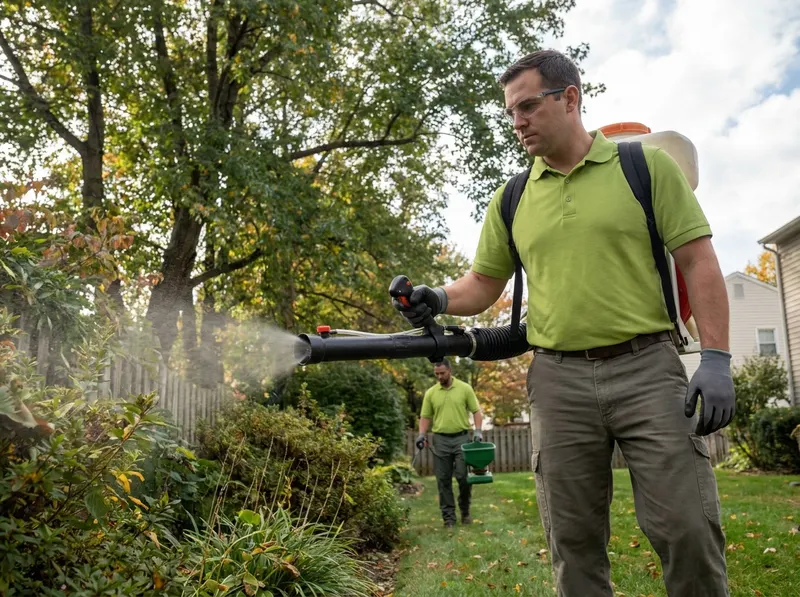
One visit fits a specific situation: a graduation party at a Laurel Lakes townhome, a backyard cookout in Steward Manor, or a rental turnover where the tenant cannot use the yard. A single barrier treatment knocks down the adult population currently resting in the shade and keeps pressure down for a stretch of weeks, but Maryland's mosquito season runs roughly April through October, and new adults keep emerging from any water within flight range. <strong>Recurring visits on a roughly three-week cycle are what hold a yard through July and August</strong>; a one-time visit is honest, useful, and temporary. We will tell you which one your property actually needs after we look at it — not before.
Laurel's geography drives the differences we see block to block. Properties near the Patuxent River corridor — Riverfront Park, the low ground off Main Street in the Laurel Main Street Historic District, and yards backing to the wetlands edging Patuxent Research Refuge — sit next to natural water we cannot and would not treat, so the plan there focuses on <strong>a tighter barrier and eliminating on-property containers</strong> that multiply the local population. Wooded half-acre lots in West Laurel and North Laurel, and the shaded older plantings around Montpelier, tend to hold mosquitoes in dense ivy, English laurel, leaf-choked window wells and canopy shade all day. Slab-on-grade homes in South Laurel and Russett more often trace back to a clogged gutter run, a kiddie pool, a saucer under a potted plant, or corrugated downspout extension holding an inch of water — <strong>a tablespoon of water is enough for Aedes eggs</strong>. Near Granville Gude Park and the Laurel Lakes basins, and along the alley storm drains in Old Town Laurel, Culex breeding in catch basins is common, and that gets larvicide rather than spray.
On arrival, the technician inspects first and shows you what was found: the container, the drain, the shaded fence line, the tarp over the woodpile. You get the checklist, so the fix is repeatable even between visits. We ask you to move pet bowls, kids' toys, open birdbaths and any harvest-ready vegetables before we start, and we skip blooming plants that pollinators are working. <strong>Products are applied per label directions, and we tell you the re-entry timing for children and pets in plain language before we spray</strong> — usually a matter of drying time, not days. If a neighbor's yard on the other side of the fence in Bond Mill or Patuxent Greens is the real reservoir, we will say so instead of selling you a fourth treatment.
What this service does not do is promise a mosquito-free yard. No treatment in Prince George's, Howard or Anne Arundel County can honestly claim that with the Patuxent, Rocky Gorge Reservoir and acres of protected wetland nearby. <strong>What a properly executed barrier plus source reduction does is cut biting pressure enough that the yard, deck and patio are usable again</strong>. That is the promise: find the water, treat the harborage, and keep it under control through the season.
| Single mosquito barrier treatment, typical Laurel lot (under 1/4 acre) | $250 – $375 |
| Single treatment, larger or heavily wooded lot (West Laurel / North Laurel, 1/4–1/2 acre) | $325 – $500 |
| Seasonal program, per visit on a ~3-week cycle (April–October) | $250 – $350 per visit |
| Pre-event treatment timed ahead of a party or outdoor gathering | $250 – $400 |
| Larvicide for untreatable standing water (catch basins, tarps, drain pipe) — added to a treatment visit | From $250 |
| Free on-site inspection and written price before any application | $0 |
Mosquito yard treatment in Laurel starts at $250, and most single visits fall between $250 and $500. Lot size, tree canopy and the number of standing-water sources drive the difference — a shaded half-acre in West Laurel takes longer than a small South Laurel townhome yard. These are ballparks; the exact price is confirmed in writing during a free on-site inspection, before any product is applied.
A barrier treatment on a Laurel yard typically holds biting pressure down for a few weeks before new adults emerge, which is why seasonal service runs on a roughly three-week cycle from April through October. Properties near the Patuxent River, Rocky Gorge Reservoir or the wetlands around Patuxent Research Refuge face constant re-entry from off-property water and generally need recurring visits rather than a single application.
Products are applied per label directions, and the technician gives you the re-entry timing before starting — for most yard applications in Laurel that means staying off treated foliage and turf until it is dry. We ask you to bring in pet bowls, toys and any ready-to-pick vegetables beforehand, and we avoid spraying blooming plants that pollinators are actively working.

Laurel sits in a corridor built for ticks. Properties in West Laurel and North Laurel back onto mature hardwood and the buffer land around the T. Howard Duckett (Rocky Gorge) Reservoir, the Patuxent Research Refuge holds a steady deer and small-mammal population just east of town, and the Patuxent River floodplain behind South Laurel and Patuxent Greens stays damp and shaded well into summer. <strong>Blacklegged (deer) ticks, American dog ticks and lone star ticks are all established in this part of Maryland</strong>, and each one behaves a little differently — which is why the inspection comes before the sprayer. In Montpelier, the culprit is often years of oak leaf litter banked against a fence line. In Old Town Laurel and Steward Manor, it is usually English ivy or a hedge row along a shared property line. In Russett and Laurel Lakes, it is frequently the mown-turf-meets-common-area edge where kids and dogs cut through.
The decision most Laurel homeowners face is one visit versus a season. <strong>A single perimeter treatment is the right fit when you have a fixed date to protect</strong> — a graduation party, a listing photo shoot, a tenant move-in, or a few weeks of heavy yard use — because residual activity on treated vegetation is measured in weeks, not months. <strong>A seasonal program fits properties where ticks are being re-supplied from outside the lot</strong>: a woodline, a greenway, a deer trail worn through the back corner. Treating that kind of yard once in June and expecting August to be clear is not how tick pressure works; hosts keep walking new ticks back in. The trade-off is straightforward — one visit costs less and solves a window of time, a program costs more and holds the pressure down through nymph season, which in Maryland runs heaviest from late May into July.
Tick control is also the wrong tool for some problems, and we will say so on the phone. <strong>If ticks are being found on a pet indoors, the treatment plan starts with your veterinarian</strong>, because a yard application does not clear an animal that is already carrying them. If you picked one up walking at Riverfront Park, Granville Gude Park or the trails near Montpelier Mansion, that is exposure away from home and a yard treatment will not change it. Habitat work matters too, and it is free advice: pull leaf litter back from the foundation and fence, keep the turf edge cut where it meets brush, move woodpiles and bird feeders away from play areas, and thin dense ground cover in shade. <strong>Ticks dry out and die in short, sunny, open lawn</strong> — every foot of edge you clean up is a foot we do not have to treat.
On safety, the answer is specific rather than reassuring: applications are directed at vegetation, edges and harborage rather than broadcast over the whole lawn, and before anything is applied you are told the re-entry and dry time for the product being used so children and pets stay off until it is safe. Laurel spans Prince George's County with sections reaching into Howard and Anne Arundel counties, and we work all of it. <strong>Find the entry. Seal it shut.</strong> Call (240) 917-2799.
| Single yard perimeter tick treatment, standard subdivision lot (Russett, Laurel Lakes, Steward Manor) | $250 - $350 |
| Single treatment, larger or heavily wooded lot (West Laurel, North Laurel, Montpelier) | $350 - $550 |
| Seasonal tick program, 3 to 4 visits April through October | $650 - $1,400 total |
| Combined tick and mosquito yard treatment, per visit | $300 - $500 |
| Tick inspection and harborage walkthrough with written findings | Included with any treatment |
Most single tick treatments in Laurel run $250 to $550, with $250 as the minimum charge; larger wooded lots in West Laurel and North Laurel sit at the upper end. Seasonal programs of three to four visits generally total $650 to $1,400. These are ballparks — the exact price is confirmed during a free on-site look at your property line before any work starts.
Tick activity in Laurel typically runs April through October, with the heaviest pressure from tiny nymphal ticks in late May through July. Starting in early spring gets ahead of that nymph peak, but a mid-season call is still worthwhile because adult ticks stay active into fall around the Patuxent Research Refuge corridor and other wooded edges.
No — treatment is aimed at where ticks actually live. In Laurel that means the woodline edge, leaf litter, fence rows, ivy and pachysandra beds, tall grass and shaded ground cover, not the open sunny turf where ticks dehydrate and die. Focused treatment of harborage zones is both more effective and less product across your yard.
Most Laurel pest decisions come down to four honest choices, and the right one depends on the building and the deadline. If you have a single wasp nest by the front door, one mouse behind the range, or a swarm of ants after a rainstorm, choose a one-time targeted treatment — it solves a defined problem, and the price is quoted before anything is applied. If you have recurring pressure from the outside — a wooded lot near the Patuxent Research Refuge, a townhouse with shared walls, or ants that come back every April — choose a quarterly preventive plan; the trade-off is a standing schedule and a recurring cost instead of one bill, in exchange for a perimeter that gets re-established four times a year and callbacks between visits. If your problem is rodents, the real decision is treatment versus exclusion: trapping and baiting clears the mice that are already inside within one to three weeks, while exclusion sealing closes the gaps under siding, around dryer vents, at garage door corners and along utility penetrations. The trade-off is straightforward — baiting alone is cheaper and faster but the same holes keep letting new mice in every autumn, while exclusion costs more up front and takes longer because it is carpentry as much as pest work. For termites, a liquid soil barrier gives you a continuous treated zone around the foundation and is usually the practical choice on a slab home in South Laurel or Patuxent Greens; a monitoring-and-bait system suits homes where digging and drilling around patios, walkways or mature landscaping is a problem, with the trade-off that bait works over months rather than immediately and depends on stations being serviced on schedule. For bed bugs in a rental or a multi-unit building, choose a multi-visit chemical program if cost and tenant scheduling matter most, and ask about heat-based options if you need the fewest possible visits — the trade-off is price and prep work against timeline. If a buyer, lender or property manager has put you on a 24-to-48-hour clock, say so when you call; inspection-first scheduling means the assessment and the written scope come before treatment, and urgent inspections are triaged ahead of routine maintenance visits.
| Service call | Upfront quote |
Your exact price is confirmed before any work begins.